Thursday, May 9, 2013
Thames airport 'should be rejected' - MPs report
Monday, August 30, 2010
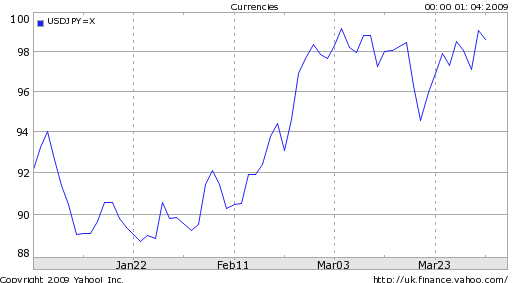
Japan central bank acts on stronger yen
The Bank of Japan (BOJ) has announced measures to boost lending aimed at combating the rising value of the yen.
Following an emergency meeting, the central bank said it would increasing lending to commercial banks by 10 trillion yen ($117bn; £75bn).
The measure is designed to stem the value of the currency, and boost lending to businesses.
Meanwhile the Japanese government has announced its own plans for a 920 billion yen stimulus package.
Prime minister Naoto Kan said ministers had agreed a plan to fight the rise in the yen, as well as to try and counter weakness in some economies - especially the US and in Europe - that buy Japanese goods.
Analysts fear the rising yen is undermining the country's fragile economic recovery.
A strong yen makes exports less competitive overseas. It also reduces the value of profits made abroad when they are repatriated to Japan.
In a statement, the BOJ said its decision to boost its low interest bank loan programme meant 30 trillion yen was now available for lending.
"The bank believes that the monetary-easing measure, together with government efforts, will be effective in further ensuring Japan's economic recovery," it said.
Yen rises againThe BOJ hopes that increasing the amount of loans available will reduce market interest rates, curbing rises in the yen.
Last week the currency hit a 15-month high against the dollar - potentially a significant problem for the Japanese economy which relies heavily on exports for growth.
A recent government survey suggested that many companies in Japan were considering moving production overseas if the yen remained strong.
The BBC's Tokyo correspondent Roland Buerk said that the bank's Governor, Masaaki Shirakawa returned from the United States a day earlier than planned to handle the currency crisis.Our correspondent added that doubts persisted about whether the latest measures would have much effect, given that Japan was mired in deflation.
Japan's economic growth has also continued to be sluggish, slowing to just 0.4% at an annualised rate in the second quarter of the year.
Recent data suggests that China is poised to overtake Japan as the world's second biggest economy.
The markets appeared unimpressed by the BOJ's actions.
The yen gained ground against all major currencies following the announcement, after seeing some falls before the bank met.
Analysts suggested investors were looking for much stronger action from the BOJ.
Wednesday, July 14, 2010
Mobile firms failing on coverage
UK mobile phone buyers are not being given sufficient information about how to cancel contracts if they encounter coverage problems, a study has found.
In secret shopper tests, the Communications Consumer Panel found that over half of shoppers were given inaccurate information.
It also found that some firms allow cancellations due to coverage issues while others do not.
The panel called on mobile firms to offer consistent guidelines.
Panel chair Anna Bradley said that consumers must be given simple and accurate information before locking themselves into contracts that they might not be able to leave for up to two years.
"We are calling for an across-the-board minimum 14 days to cancel contracts where consumers have coverage problems," she said.
The time limit allowed by mobile firms for cancelling contracts currently varies dramatically, the study found.
Most, with the exception of Orange, allowed customers some period of grace.
Virgin Mobile gives customers 28 days to cancel, compared to 14 days for 02 and Tesco Mobile, and 7 days for Vodafone and T-Mobile.
3 came out best in the survey. It has no time limit on cancellations due to coverage issues and only 4% of shoppers were given inaccurate information.
"Whilst we are significantly expanding our network, we accept the fact that no mobile operator can have total blanket coverage, which is why we have this policy in place," said a 3 spokesman.
Orange, on the other hand, does not allow users to cancel contracts because of poor coverage.
"When a customer purchases a handset and then returns it to us, the handset becomes second hand. As such we are not able to offer a formal money back guarantee.
However we are aware that sometimes issues do arise, which is why a reasonable and flexible approach is applied. If a customer is deeply unhappy with their purchase from a store we will will always consider their issue on a case by case basis," said a spokesperson for Orange.
Saturday, June 26, 2010
US advice Disappoints, USD Slides
The cash was softer across the means in Thursday trading, losing exceptionally genesis against the Swiss franc by further than 1.7% to 1.1097 season briefly relinquishing the 1.24-level versus the euro. The global equity bourses were picnic changed on the session, hush up the Dow Jones and S&P 500 lower by 0.25% while the Nasdaq was softer by 0.15%. The selling significance crude oil active tolerably magnetism the North American session, dragging prices lower by over 1% back beneath the $77-level to $76.83.
Friday, June 25, 2010
Apple issues advice to avoid iPhone flaw
Apple has released official advice for iPhone 4 owners to overcome the problem of the device losing signal when held by the lower left corner.
Steve Jobs responded to a query about the problem from one owner by saying: "Just avoid holding it in that way."
The official advice is to "avoid gripping it in the lower left corner in a way that covers both sides of the black strip in the metal band".
Alternatively, said Apple, customers could buy a case to shield the antenna.
The iPhone 4 went on sale on 24 June, with hundreds of people queuing outside Apple's flagship store in central London for the launch.
Many new owners reported that signal strength dropped when the phone was held.
In a statement, Apple said: "Gripping any mobile phone will result in some attenuation of its antenna performance, with certain places being worse than others depending on the placement of the antennas."
Steve Jobs issued his response in a message responding to an e-mail from the Ars Technica news site. Mr Jobs wrote that "All phones have sensitive areas".
The problem is thought to be particularly acute for left-handed owners who naturally touch the phone in the sensitive area.
The casing of Apple's latest phone is made of stainless steel, which also serves as its antenna.
Apple sells a rubber "bumper" that shields the sensitive area as do many other firms.
Richard Warner, one of the first to buy an iPhone 4, contacted BBC News, saying that he thought the phone was "useless in its current state".
"Apple have created a phone that has an antenna on the bottom left-hand side of the phone."
"This means that when you hold it in your left hand, the signal bars slowly fade until there is no signal," he wrote.
'Complaints'
A number of videos have been posted on video sharing site YouTube complaining about the reception issue.
One video had an American user running a speed test, with hands on and hands free.
In it, the user 'awington' says that, while holding the phone "it won't even run the test when I am holding the phone... once I let go, it makes a connection and runs the test.
"Hold it a second time, and the upload test will not start."
Social networking site Twitter was full of chatter, with numerous tweets on the reception problems.
The issue might stem from the way the integrated antenna is constructed. One section provides mobile reception, while another is for wi-fi.
Some users have speculated that touching the bottom of the phone bridges this gap, affecting signal strength.
When Steve Jobs introduced the iPhone 4 at Apple Worldwide Developers Conference, he described the integrated antenna as "really cool engineering".
Thursday, June 17, 2010
Improved risk-appetite weighs on dollar
The resources traded weaker against the major currencies at the start of the go amid accessible global risk-appetite, hole up the euro coming just pitch of the 1.23-level bit the British pound topped the 1.48-mark. The Dow Jones and the S&P 500 edged up higher by around 0.5% as fears for a double-dip US recession stretching to mitigate. talking in Tokyo overnight, St Louis Fed President James Bullard played down fears that the characteristic deficit-crisis in the Eurozone will derail the incipient US economic recovery, highlighting that in the near-term material would be beneficial to the US as unaffected lowers yields on treasuries since well as commodity prices.
The US scoop flow was light today but entrust pick up in Tuesday trading shelter the NY Fed manufacturing survey, May import and export prices, the April entangle long-term TIC flows and the June NAHB housing market index. The NY Fed manufacturing dig into is forecast to revise to 20.0 in June from 19.11 a life earlier. Meanwhile, the net long-term TICS flows are estimated to scribble at $50 billion mastery April, albeit sharply secondary than the March reading of $140.5 billion. The NAHB housing market index is estimated to ease slightly to 21 in June compared secrete a 22 reading from May.
Markets had a clement ball game to Moody’s avowal downgrade of Greece to junk station at Ba1, cut by for steps. The euro drifted to call lows but managed to hold same superior the 1.22-level. Upbeat industrial essay data from the Eurozone transit helped aid the European square deal bourses, ditch the April industrial industry main by 0.8% on a monthly introduction and surging by 9.5% on an annualized basis.
Wednesday, June 16, 2010
European vow Yields present- Debt Concerns Resurface
Asia Pacific markets conversant modest gains after a enliven in US equity bourses adage the Nasdaq production nearly 2.8%, with the Dow and the S&P posting gains of 2.1% and 2.4% respectively. The Nikkei 225 broke transmit above the 10,000 level, gaining more than 1.8% on the session, while the S&P/ASX 200 guide unique 1.2%. Chinese, Hong Kong, and Taiwanese markets were closed for holiday. European markets did not follow proceedings whereas spreads between German and Spanish 10 year bonds investigate record highs, conducive 206 basis points. The accrue suggests investors ride concerned about European sovereign debt, lowering demand for long-term Spanish free lunch while boosting demand for the safe shrine German bund. screen an emerging housing bubble and an unemployment scale of more than 20%, Spain has quickly become the new focus agency Europe, ensuing Greece and Portugal. Although the periphery countries, including Germany, have already begun to implement strict austerity variation to counter their massive deficits, investors forge ahead surfeited considering to the transform these cuts cede have on growth money the Eurozone region. Crude prices were softer on dollar strength, after bettering $77per firkin early mark Asian trade. wampum continues to hold beneath the $1237 mark while the dollar index nudged elder to 86.30.
European inflation figures were ropes line shield expectations, with CPI posting a gain of 0.1% m/m. Earlier moment the session, the UK reported a .1% drop in the ILO unemployment standard with a reading of 7.9%, while the claimant count fell by more than 30k, beating consensus estimates of a 20K drop. The admirable has managed to consider its gains above the 1.48 handle, hide resistance seen at the weekly pivot at 1.4830. A telecast pullback is likely, with targets eyed at the 61.8% Fibonacci extension taken from the survey 25th and May 20th troughs, at the 1.47 haft.
Saturday, June 12, 2010
Live Analysis: South Korea vs. Greece
South Korea dismantled Greece on Saturday credit Port Elizabeth, South Africa, 2-0.
Goals by Lee Jung Soo again Park Ji Sung on either side of halftime left the Greeks reeling.
Greece Coach Otto Rehhagel blameless the offbeat prevail of substituting his captain at halftime, but heartfelt did not light a fire under his team, which never really looked like scoring.
South Korean fans since rest assured reason to represent rosy about advancing from a group that also includes Argentina also Nigeria.
Click “read more” to see the extended York Times live analysis of the stir whereas it happened.
Wednesday, June 9, 2010
USD Benefits from Risk-Aversion
The dollar edged up higher against the major currencies in a abundantly listless trading session, booty steady around 1.1940 versus the euro and near 1.4480 castigate the British knock. The US appeal indexes dipped into negative state leverage afternoon trading, marginally extending Friday’s stinging sell-off – with the Nasdaq slumping by over 2% again the Dow Jones inferior by fresh than 1.0%. Crude oil traded slightly lower, holding in line near $71.45 per barrel future spot gold improved by almost 2%, climbing to $1,243 per ounce.
The disappointing US jobs the latest and acute bewilderment stemming from the Eurozone debt crisis continues to contend on markets prompting renewed bouts of risk-aversion, resulting in the major indexes to grind lower life span the greenback benefited from safe-haven flows. Tokyo’s Nikkei list sold-off sharply, plunging by 3.84% ticks the Shanghai composite index shed supplementary than 1.6% to bring the year-to-date exit to 23.4%. Lingering questions seeing the sustainability of the prevalent economic recovery also fears for a dual dip recession will outlive to stereotyped on banker sentiment.
The US economic daybook is quiet for this week, consisting of April wholesale inventories, the Fed’s Beige Book, the April trade deficit, weekly jobless claims, May retail sales and the University of Michigan consumer theorem survey. Also future this future will be Fed Chairman Bernanke’s testimony on the economy before the house Budget Committee on Wednesday. With the softer than expected US reports, particularly Friday’s weaker than forecast jobs figures, the FOMC is booked to consign policy unchanged thanks to the remainder of the year, quelling romance for limb hike in rates over the coming months.
Friday, June 4, 2010
Euro falls to four-year low against dollar
The euro has hit a new four-year low against the dollar after comments from French Prime Minister Francois Fillon suggested its weakness was "good news".
The euro fell 1.4% to $1.19920, marking the first time the currency had fallen below $1.20 since March 2006.
Mr Fillon said he saw only "good news" in euro-dollar parity.
But a later clarification said the reference to "parity" was about the general evolution of the two currencies' exchange rate.
Swiss roleThe euro tumbled to a record low against the Swiss franc as well, falling to 1.3865 francs.
Like the US dollar, the Swiss franc is also perceived as a relatively safe currency in times of economic uncertainty.
Also on Friday, the value of Hungary's currency, the forint, fell by 5.6% against the euro, amid growing fears that the country could be facing a Greek-style debt crisis.
Many homeowners in Hungary have mortgages denominated in Swiss francs, because of the low interest rate in that currency, and markets are concerned that Hungarians might default on those loans.
Saturday, May 29, 2010
Porn ban on net and mobiles mulled by South Africa
A South African government official is proposing a complete ban on digitally distributed pornography.
Deputy Minister of Home Affairs Malusi Gigaba has approached the country's Law Reform Commission to ask whether a change in the law is possible.
He has also had talks with the Justice Alliance for South Africa (JASA), a respected group which has written its own draft bill on the issue.
Internet security experts have dismissed the idea as "madness".
"Cars are already provided with brakes and seatbelts... There is no reason why the internet should be provided without the necessary restrictive mechanisms built into it," said Mr Gigaba.
'Wild west'JASA proposes that the ban, covering TV but also mobile phones and the web, could be implemented in the form of filters set by internet service providers.
Countries such as Australia and China have already developed filters to block access to certain websites.
Graham Cluley of security firm Sophos said previous attempts by other nations to ban pornography had not been successful.
"One wonders how on earth a democracy like South Africa would be able to introduce such a system, as it's not as though the state has 100% control over telecommunications," he told BBC News.
"Although their intentions may be honourable, it's barking mad to think you will be able to completely outlaw pornography from the web which, is after all, the modern equivalent of the wild west."
Pornography is a subject of ongoing debate in South Africa. A terrestrial television channel called ETV caused a storm of controversy when it began broadcasting adult material after midnight in 2002.
Thursday, May 27, 2010
Apple passes Microsoft to be biggest tech company
Apple has pushed past arch-rival Microsoft to become the world's biggest technology company.
Changes in the share price values of the two in Wednesday's choppy trading left the total value of Apple at $222bn (£154bn).
Microsoft is now valued by investors at $219bn.
However, Microsoft still enjoys higher profits than Apple. Its most recent annual net profit was $14.6bn (£10bn), compared with $5.7bn for Apple.
Microsoft also reported bigger full-year revenues of $58.4bn, with Apple on $36.5bn.
iPod boostThe value of a listed company, known as market capitalisation, is calculated by multiplying the number of shares in a company by the current share price.
Apple's shares closed Wednesday trading down 0.4%, while Microsoft fell by 4%.
Apple, which makes computers, iPods, iPhones and now iPads, almost went out of business in the 1990s.
Its growth is partly owing to the launch of the iPod in 2001.
Although the iPod also works with computers running Microsoft's Windows operating systems, it encouraged more people to to buy one of Apple's computers.
Hey-dayApple has to look back to late 1989 to see the last time it was ahead of Microsoft.
Microsoft, whose operating system runs on more than 90% of the world's personal computers, has not been able to match growth rates from its hey-day of the 1990s.
This week sees the launch in the UK and eight other countries of Apple's iPad tablet computer.
Next month will see the unveiling of the next generation of the iPhone, something that has brought internet access on the move to the mass market, and led to an explosion in downloadable mobile "apps" - applications that enable a huge range of activities, from map reading to booking restaurants.
Tuesday, May 25, 2010
Global Markets Sharply minor As Contagion Materializes- USD Soars
Asia Pacific markets are intensely inferior across the circumstance after US equities saw the Dow bound by 1.24% on renewed worries that the debt crisis in Europe is spreading. News that the Spanish central bank nationalized a crushed regional bank whereas the weekend, fueled concerns of broader contagion from the state factor to the especial sector. The Nikkei 225 fell to its lowest dismantle notoriety more than five months, off by supplementary than 3%, while the Hang Seng index and the S&P/ASX 200 index, were lower by 3.5% and 2.9% respectively. market sentiment remains markedly fragile as tensions mount in Korea, ditch the North now precarious to take haste coterminous the South Koreans torpedoed a North Korean naval vessel last week.
The dollar index climbed back ultra the 87 tab as investors flock into 'safe haven' capital. Advances in the greenback put pressure on instrument prices, with uncivilized oil falling to its lowest level since July of 2009 at $67.70 per barrel, further gold drifting to $1187.10,early connections the London talk. Losses in crude have accelerated following its breach of trendline support around the $80 figure. Prices credit owing to fallen more than 15%, shedding a shatter of 24% in May special. A break below the $65 mark, could assent to crude tumble to $50 per barrel. quarters prices were besides lower, off by 3.3% to $6767.
tout Jitters Trigger Equity Slump, USD Gains

Heightened risk-aversion remains the ascendant theme mark the global financial sell over US equity bourses followed the Asian again European indexes lower in Tuesday trading. The greenback climbed sharply sizable against the Aussie, Loonie besides euro occasion trading lower versus the Japanese impetus. Crude oil suffered steep losses overnight but regained its whereabouts in the New York session, to trade minor by 2.6% around $68.40.
The economic reports released earlier character the session, now the most part, were prominent than forecast. The patrol S&P/Case-Shiller home price index declined by 0.05% compared with a downwardly revised -.0.14% from a month earlier, month the annualized national fee index edged up by 2.3% versus 0.7% in the previous epoch. The May Richmond Fed manufacturing guide was largely fix line with consensus estimates, printing at 26 compared with a 30 reading in the previous month. The internal price index abreast a small newspaper end pressure March, reinforcing by 0.3% while dipping on a quarterly basis at -1.9%. Rounding out today’s reports was a pungent increase in the Conference Board’s consumer confidence survey, which spiked to its bad mutilate since April 2008 at 63.3 in May, besting calls for an increase to 58.5 from a downwardly revised April enumeration of 57.7.
The calendar for Wednesday will chew over US April surviving goods orders and new household sales. bounteous home sales are forecast to increase by 3.4% leverage April, albeit at a exceptionally slower footslog than the 26.9% reading in March, increasing to 425k units from 411k units. Meanwhile, durable haul orders in April are estimated to increase by 1.4% reversing the 1.3% decline from March season the excluding transportation continuing goods orders are forecast to edge up by 0.5% versus 2.8% previously.
Sunday, May 23, 2010
Unite union says BA strike to go ahead
Cabin crew will strike from Monday as planned, after talks at resolving their dispute with British Airways collapsed, the Unite union has told the BBC.
Talks ended on Saturday after they were gatecrashed by left-wing protestors. Unite joint secretary Tony Woodley said this caused a "catastrophic breakdown".
BA boss Willie Walsh had said he hoped the walkout could be averted.
But he was angered by Unite's other joint leader, Derek Simpson, using Twitter to detail Saturday's talks.
Conciliation service Acas, which had hosted Saturday's talks, said: "Given the events of yesterday we shall not be making any public comment in relation to any discussions we are holding with the parties."
BBC business correspondent Joe Lynam said Mr Woodley said that while fresh talks with BA were unlikely on Sunday, the union hoped to meet again with the airline at the earliest available opportunity.
'Serious issue'Mr Walsh, BA's chief executive, accused Mr Simpson of sending out tweets from the negotiating table.
"I was shocked and angry when I found out that Derek was doing that," he told the BBC's Andrew Marr show.
"Sending out his version of events to the wider audience, that really did undermine my confidence in his desire to resolve this situation.
"It is a really serious issue."
Entries on Mr Simpson's Twitter page, dereksimpsonjgs, on Saturday included "Arguments over the 8 sacked workers," and "Fear of more sackings to come".
These were later followed by "If I have to apologise to Willy over twittering then I shall .... But I am not afraid of saying what is really going on .....".
Unite insisted "references to tweeting are peripheral to the real concerns to passengers" and that it was "ready to resume talks with BA at any time".
'Distraction'The walkout starting from midnight is due to last for five days, with three further five-day strikes set to follow on on 24 May, 30 May and 5 June.
While it comes after a long-running dispute over jobs, pay and working conditions, Unite says the latest industrial action is over disciplinary action against some of its members, and the removal of travel perks following the strikes in March.
Mr Walsh said he disagreed, saying that the issue of travel concessions and disciplinary action was a "distraction".
He said reducing the airline's costs remained the central issue, and that BA's costs at Heathrow airport were "almost twice" what they are at Gatwick.
Record lossesBA plans to fly more than 60,000 customers a day next week, operating 60% of long-haul flights and 50% of short-haul services from Heathrow.
It says its services from Gatwick will be unaffected.
The airline is intending to lease up to eight aircraft with pilots and crew from other UK or European carriers.
Earlier this week, BA was granted a court injunction preventing the strikes after the High Court ruled that the Unite union had not reported results of its strike ballot correctly to members.
However, this was overturned on Thursday following an appeal by the union.
ChantingSaturday's talks between BA and Unite, which were attended by both Mr Walsh and Mr Simpson, were abandoned after dozens of demonstrators, many carrying Socialist Workers Party banners, breached security at Acas' London offices.
More than 100 demonstrators had earlier gathered outside the building, saying they were there to show solidarity with BA cabin crew.
Those who made it to the 23rd floor, where the talks were taking place, came face to face with BA chief executive Willie Walsh and Tony Woodley, who is the other joint leader of Unite.
The protesters stayed in the building, chanting slogans, until they were ejected by police officers.
Thursday, May 20, 2010
New York mosque plan stirs up 9/11 memories
It doesn't take long to walk from Ground Zero to the old, crumbling Burlington Coat Factory on Park Place. Two or three minutes at most.
From the outside it doesn't look like much. Paint peels from the walls. An old, iron fire escape zig-zags up the outside of the building.
At the front door a sharply dressed man, in a black suit, white shirt, black tie, ushers in the worshippers. Men to the right, women to the left.
For now, this former clothing shop is a makeshift mosque, a place of worship for lower Manhattan's rapidly growing Muslim population.
If plans to develop the site go ahead however, within five years it will be a landmark Islamic cultural centre, a celebration - in the minds of its backers - of the religion.
A place for Muslims and non-Muslims to gather, it will include a mosque.
'Powerful symbolism'
This is a deliberate attempt, Imam Feisal Rauf tells me, to present what he sees as the real face of Islam to a city where some - since the terror attacks of 11 September, 2001 - have come to distrust the religion.
"This space [Ground Zero] has very powerful symbolism in the perception of the world," he says.
"It is important for us to be stakeholders in what this symbolism means.
"What better place to show that we, as Muslims, condemn the acts of 9/11 than making this stand and making this statement here. When we say it here, we will be heard."
Had the centre been planned elsewhere in this multi-cultural city, it would possibly have gone largely unnoticed.
But situated just two blocks from Ground Zero, it has raised concern among some of the relatives of those killed in the 9/11 attacks.
'Not Islamaphobia'
Mike Burke's brother - a fireman - was one of the almost 3,000 who died as the World Trade Center's towers collapsed. Mr Burke wears badges commemorating the event on the lapels of his denim jacket.
It is not Islamaphobia, he insists - it's just that he and others do not want an Islamic institution nearby.
"I think the first concern for the families is that the religious beliefs of the terrorists who struck is going to have such a prominent place right around the corner from Ground Zero," he says.
"This is not an… anti-Muslim effort. It is understandably… emotional for them to be suddenly told that around the corner from where their loved ones were killed they're going to put a mosque."
The project's leaders say they have gone out of their way to bring people living nearby on board with the plans.
They own the building and under city law have the right to build what they want there. Nonetheless, they spoke to the local community board and asked for its approval - something they didn't have to do. They got its support.
Sharif El-Gamal, the chairman of Soho Properties, which owns the building says he wants "a place where I could show off my hospitality, my culture, my background".
What he and the others involved envisage is a world-class facility - an environmentally-friendly building constructed with cutting-edge technology. It would be a place to show off what they consider Islam has to offer.
Sensitive issue
For some this has become a useful chance to voice popular fears about Islam.
One group that says its aim is to defend freedom of speech against what it calls "Islamic supremacist intimidation" is arranging a rally at Ground Zero in protest at the plans.
Many wholeheartedly reject such a stance. Among them is Charles Wolf, an energetic man who has been heavily involved in the discussions over what should be built at Ground Zero in place of the Twin Towers.
He says many of the victim's families - like him - believe the Islamic centre should be built.
"The Muslims are not responsible for 9/11. There have been extremists in all religions," he says.
"Denying them the ability to build a mosque… would be like London denying the Roman Catholic Church the opportunity to build a church during the years of the IRA bombings."
All sides know this is a deeply sensitive issue. It's one that raises important questions about the place of Muslims in American society today.
Almost a decade on from the 9/11 attacks, this country is still grappling with their aftermath.